



Resilience by construction: how index evolution drives earnings strength
Equity markets have shown resilience amid persistent headwinds, supported by index evolution and earnings strength
Despite multiple risks that emerged over the past year – tariffs, higher energy prices, upward pressure on interest rates and evolving growth and earnings outlooks – equities have shown remarkable fortitude.
The S&P 500 has gained 10% year-to-date (YTD) with eight of 11 sectors in positive territory for the year. Notably, the move higher was driven by earnings rather than multiple expansion. In fact, while the S&P 500 has moved higher YTD, the next 12-month price-to-earnings estimate has moderated from 22.2x to 21.4x. Contrarily, consensus estimates now point to a remarkable 24% year-over-year earnings per share growth for the S&P 500 in 2026 – levels usually seen only during recoveries following recessions.
Perhaps unsurprisingly, one of the biggest questions market participants have at this stage is: How have corporate earnings been so resilient despite the risks that have materialized thus far?
Fundamentals: remarkable strength despite higher energy prices
S&P 500 earnings have shown impressive strength in 2026 despite higher energy costs largely because the index itself looks very different than it did in prior cycles. Most importantly, it is far less energy-intensive than in the past. Over time, index earnings have become less exposed to traditional manufacturing, where higher energy costs directly pressure margins, and to energy-sensitive areas of consumer spending, where elevated fuel prices can weigh on demand.
Today, the composition has shifted decisively toward asset-light, service-oriented and technology-driven businesses. As a result, energy is a smaller share of total cost structures for the average S&P 500 company, dampening the direct margin impact of rising oil. This declining energy intensity reflects not only sectoral shifts but also operational changes within firms.
Advances in energy efficiency, more flexible supply chains and the increasing digitization of business models have all reduced the amount of energy required per unit of output. As a result, the sensitivity of corporate margins to oil price shocks is structurally lower than in prior decades. Another important factor is improved pricing power across large-cap corporations. Following the post-pandemic inflationary period, many firms have demonstrated an increased ability to pass on higher input costs to end customers. While not universal, this has reduced the typical margin compression associated with rising energy prices, particularly among firms with strong competitive positioning and differentiated value propositions.
Margin resilience: cost discipline and operating leverage
Another important, and often underappreciated, factor supporting earnings strength is the shift toward greater capital and cost discipline across large-cap corporations. In the years following the pandemic, firms have become more focused on efficiency, margin durability and return on invested capital rather than purely top-line growth. This has led to leaner cost structures, tighter control over operating expenses and more scalable business models.
At the same time, operating leverage has structurally shifted in favor of larger firms, particularly within asset-light and technology-enabled sectors where fixed costs are relatively high but variable costs remain low. This dynamic allows revenue growth, although uneven across the economy, to translate more efficiently into earnings. As a result, many companies are better positioned to absorb input-cost volatility, including energy, without a proportional impact on profitability.
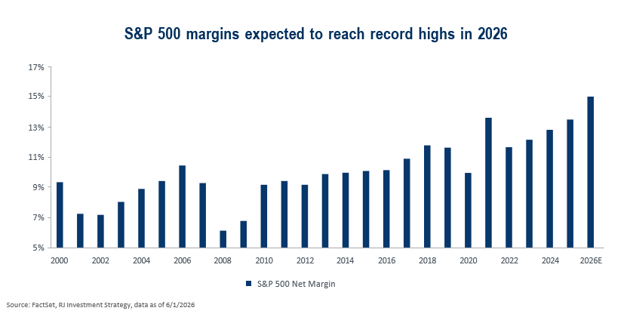
Taken together, stronger cost discipline and improved operating leverage have reduced the sensitivity of earnings to external shocks, reinforcing the broader resilience seen at the index level. This evolution in corporate behavior, along with greater exposure to more insulated secular growth trends, is reflected in S&P 500 net margins projected to reach a record high of 15% in 2026, underscoring the durability of profitability even in a more challenging cost environment.
Concentration effects: the rising dominance of AI-driven earnings
Even more critical is the increasing concentration of earnings in a narrow set of AI-enabled industries, particularly semiconductors and cloud computing. The modern S&P 500 is now nearly half AI-focused when viewed through the lens of earnings contribution and index composition.
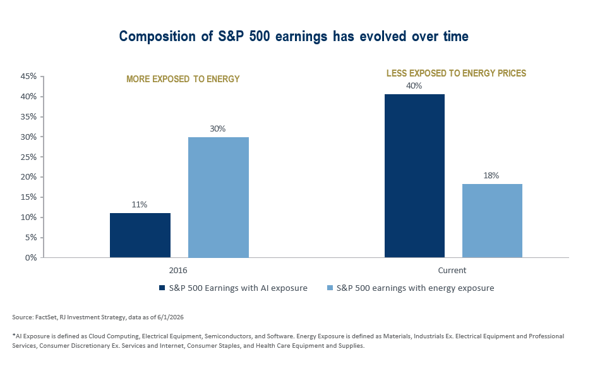
These industries are benefiting from powerful secular demand tied to artificial intelligence adoption, data center buildouts and enterprise digitization. Unlike traditional industries, their revenue growth is driven less by cyclical factors and more by structural trends, allowing them to offset cost pressures elsewhere in the index. In fact, 10 years ago, 30% of S&P 500 earnings were directly exposed to energy prices while only 11% were tied to today’s AI beneficiaries.
Today, AI-related firms are responsible for 40% of S&P 500 earnings while only 18% of index earnings are exposed to energy prices. Importantly, the AI investment cycle is also creating second-order support across the broader index. Data center buildouts and infrastructure expansion are driving demand for industrial equipment, electrical components and power generation, benefiting sectors that would otherwise be more exposed to higher energy costs. This capex-driven demand spillover further cushions earnings in aggregate.
Earnings divergence: narrow breadth beneath strong headline growth
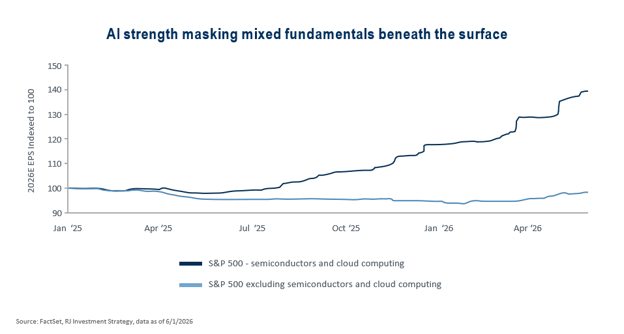
This divergence between macro pressures and secular growth themes is clearly visible in earnings revisions. Over the last two years, 2026 earnings estimates for semiconductors and cloud computing companies have been revised higher by roughly 39%, reflecting strong pricing power, accelerating AI demand and sustained capital investment in AI infrastructure.
In contrast, the rest of the index has seen aggregate earnings estimates revised modestly lower, by about 1%. In other words, while much of the S&P 500 is experiencing margin pressure from higher input costs, including energy, the outsized growth of AI-linked industries is more than compensating at the index level.
At the same time, this dynamic also points to narrower earnings breadth, with a smaller group of companies driving a disproportionate share of index-level growth, leaving aggregate earnings increasingly dependent on the durability of AI-driven demand and execution.
Bottom line: index construction largely responsible for resilient fundamentals
Taken together, the resilience of corporate earnings is less about uniform strength across all sectors and more about composition effects. A less energy-intensive cost base, combined with the increasing dominance of high-growth, AI-driven industries, has allowed aggregate earnings to hold up even in the face of rising energy costs. This structural shift underscores why headline index earnings can remain strong even when underlying conditions are more mixed.
All expressions of opinion reflect the judgment of the author(s) and the Investment Strategy Committee and are subject to change. This information should not be construed as a recommendation. The foregoing content is subject to change at any time without notice. Content provided herein is for informational purposes only. There is no guarantee that these statements, opinions or forecasts provided herein will prove to be correct. Past performance is not a guarantee of future results. Indices and peer groups are not available for direct investment. Any investor who attempts to mimic the performance of an index or peer group would incur fees and expenses that would reduce returns. No investment strategy can guarantee success. The S&P 500 is an unmanaged index of 500 widely held stocks that is generally considered representative of the U.S. stock market. Keep in mind that individuals cannot invest directly in any index, and index performance does not include transaction costs or other fees, which will affect actual investment performance. Individual investor's results will vary. Investing in oil involves special risks, including the potential adverse effects of state and federal regulation and may not be suitable for all investors. Economic and market conditions are subject to change. Investing involves risks including the possible loss of capital. The information has been obtained from sources considered to be reliable, but we do not guarantee that the foregoing material is accurate or complete. Diversification and asset allocation do not ensure a profit or protect against a loss.